
Lip Liner and Lip Shaping: how to line lips correctly for every lip shape

Lip liner does three jobs: it gives the lipstick a clean, bleed-proof edge, it gives it something to hold on to, and — when the face asks for it — it reshapes the border by a fraction. The visible dark outline of the 1990s is not lining; it is the mistake lining exists to avoid. This guide covers the method, believable overlining, correcting asymmetry, and the placement map for the common lip shapes.
Lip liner: a working definition
A lip liner is a pencil — sharpenable or retractable, sometimes a fine brush with a cream — in a colour matched to the lips or the lipstick, used to define the vermilion border (the edge where lip meets skin), fill the lip as a base, and adjust the shape within a hair's breadth of the natural line.
The natural lip has a cupid's bow (the double curve at the centre of the upper lip), two peaks, a centre of the lower lip, and corners. Lining works with those landmarks.
The method
- Prep. Exfoliated, moisturised lips; blot the balm so the liner grips.
- Sharpen (or wipe a retractable) — for hygiene and for a fine line.
- Map the cupid's bow. Draw the two peaks first as short strokes, then the dip between them — a small X guides the shape.
- Line the centre of the lower lip with a short stroke.
- Connect to the corners with short, feathered strokes, staying on the natural border; the corners are never overlined.
- Fill the lip lightly with the liner — this is the base that keeps lipstick even and long-wearing.
- Blend the edge inward with a lip brush or a clean fingertip so no line is visible.
- Lipstick with a brush from the centre out; blot; second thin coat.
Overlining that stays believable
Overlining works only where the lips are already fullest — the centre of the top and bottom lips — and only by a hair's breadth. Draw a fraction outside the border at the centre, taper back to the true line before the corners, and use a liner matched to the lipstick so the extension reads as lip, not as line. A highlight on the cupid's bow and a lighter shade at the centre of the lower lip add fullness without any overlining at all.
Overlined corners, a liner darker than the lipstick, or an extension you can see at arm's length are the three things that make it obvious.
Correcting uneven lips
Most lips are uneven — one peak higher, one side fuller, an upper lip thinner than the lower. Line the smaller side a fraction outside its border and the larger side exactly on it, with short feathered strokes, checking from arm's length until the two sides read as one shape. A slightly deeper liner at the corners and the bow, over a matching liner, adds definition on lips that lack a clear border.
The placement map
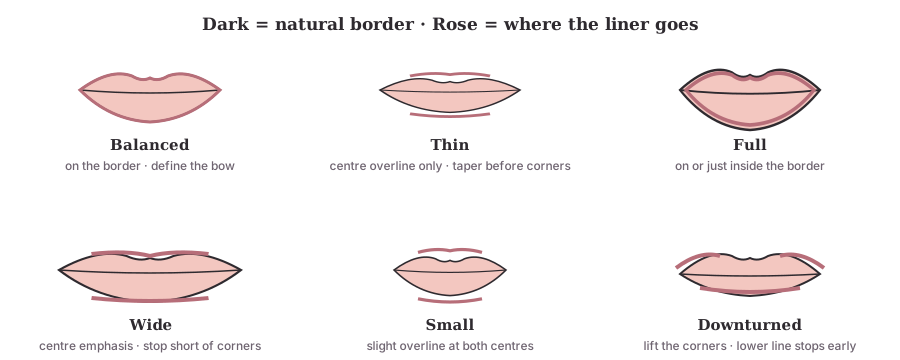
- Balanced: line on the natural border; define the bow.
- Thin: a hair's breadth outside the border at the centre of both lips; taper to the true line before the corners; light centre shade.
- Full: line exactly on or a fraction inside the border; matte or satin lipstick; skip the centre highlight.
- Wide: emphasise the centre and soften the corners — stop the liner a fraction short of the corners and keep colour concentrated in the middle.
- Small: slight overline at the centre top and bottom; define the bow; a satin or gloss centre.
- Downturned: lift the corners by lining a fraction above the natural corner on the upper lip and stopping the lower line before it drops; keep the corners clean with concealer.
Colour
Match the liner to the lipstick, or one shade deeper for definition. A nude liner in the lips' own colour is the professional default under any shade. Undertone decides the family: warm skin takes brick, coral and warm brown liners; cool skin takes blue-red, berry and mauve; olive takes warm brick and brown-red. See Skin Undertone Explained.
For brides
A bridal lip is lined, filled, brushed, blotted and layered — the liner-fill is what survives the first hour. Waterproof or long-wear liners under a satin lipstick hold through rituals and food; a gloss centre is added last, if at all, because gloss migrates. The touch-up kit carries the liner, the lipstick and a small brush.
Common mistakes
- A liner darker than the lipstick — the outline.
- Overlining the corners.
- Lining with a blunt pencil.
- Skipping the fill, so the lipstick fades from the centre and leaves a ring.
- Gloss over an overlined lip — it bleeds past the line.
From Chhaya Yadav's experience
Observations from bridal and teaching work in Jaipur — professional observations, not statistics.
- Almost every bride's upper lip is thinner than her lower lip, and a hair's breadth at the centre of the top lip — nowhere else — is the whole correction.
- The nude liner is in every kit I pack. It defines, fills and holds under any lipstick without changing the colour.
- Students overline the corners because it looks fuller in the mirror; in the photograph it looks like a moustache of lipstick. Centre only.
- Feed the bride before the lip. The lip is the last thing done before draping, after she has eaten, so the fill-and-blot layers survive the day.
Frequently asked questions
What is lip liner actually for? Three things: a clean, bleed-proof edge; a base that helps lipstick last; and, when needed, a subtle reshaping of the border — a fraction fuller, more symmetrical or more defined. It is not for drawing a dark outline.
How do I overline without it looking obvious? Overline only at the centre of the top and bottom lips, a hair's breadth outside the natural border, and taper back to the true line before the corners. Match the liner to the lipstick, and blend the liner inward so there is no visible edge.
What colour lip liner should I use? Match the lipstick, or go one shade deeper for definition. A nude liner matched to the lips' own colour is the professional default under any shade. Never a dark liner under a light lipstick.
How do I fix uneven lips? Line the smaller or lower side a fraction outside its natural border and the larger side exactly on it, with short feathered strokes, until the two sides read even. Judge from arm's length; the goal is a symmetrical lip, not a symmetrical line.
How do I make lipstick last? Exfoliate and moisturise the night before, blot the balm, line and fill the whole lip with liner, apply lipstick with a brush, blot with tissue, apply a second thin coat, and keep a small brush and the lipstick for touch-ups.
Key takeaways
- Liner defines, holds and adjusts by a fraction; it never outlines.
- Map the bow, line the centres, feather to the corners, fill, blend inward.
- Overline only at the centre, never the corners, in a matching colour.
- Fix asymmetry by lining the smaller side outside and the larger side on the border.
- Line, fill, brush, blot, layer — that is why bridal lips last.