
What is Airbrush Makeup? How it works, the equipment, and who it suits
Airbrush makeup is makeup applied as a fine mist. A small compressor pushes air through a pen-shaped gun; the moving air draws a thin, purpose-made foundation from the gun's cup and atomises it into tiny droplets that settle on the skin in an even, sheer layer. Build two or three passes and you have a base with no brush strokes, no sponge marks and no visible edge.
That is the technique. What makes it work — or fail — is the equipment, the formula base, the pressure, the distance and the artist's hand. This guide explains each, from the compressor to cleaning the gun, and is honest about where airbrush is the right choice and where a brush is better.
Airbrush makeup: a working definition
Airbrush makeup is an application method, not a category of product. Any thin enough liquid can in principle be sprayed, but airbrush makeup uses foundations, blushes and highlighters formulated specifically for atomisation: low viscosity, finely milled pigment, and one of three solvent bases (silicone, water or alcohol).
The result is different from a brushed base in three ways:
- Evenness. Droplets land uniformly; there is no directional stroke.
- Thinness. Each pass deposits very little product, so coverage builds gradually and stays light.
- Distance. The artist never touches the skin during the base — no tool drags across it, which matters for freshly exfoliated or sensitive skin.
Airbrush is often confused with HD makeup. HD describes the products and finish; airbrush describes how the product arrives on the face. Many airbrush foundations are marketed as HD, and HD liquids are usually applied with brushes. The two are compared properly in the HD vs airbrush comparison in this hub.
How an airbrush system works
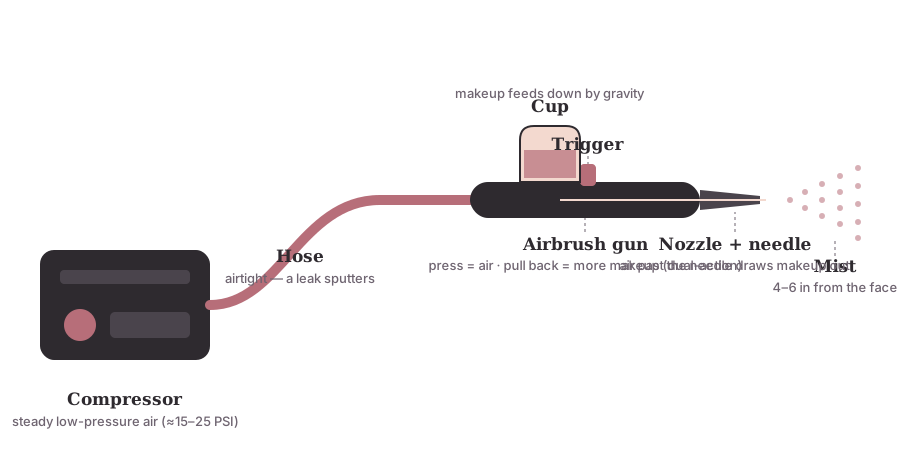
The compressor is a small electric pump that supplies a steady stream of air. Makeup compressors are quiet, low-pressure units; most work in the region of 15 to 25 PSI, far below the pressures used for spray painting. Many have an automatic stop that halts the motor when the trigger is released.
The hose carries air from the compressor to the gun. It must be airtight; a leak shows up as sputtering.
The gun (also called the airbrush or pen) is where the makeup meets the air. Makeup sits in a small cup on top of the gun and feeds down by gravity. When the trigger is pressed, air rushes past the tip of a fine needle inside the nozzle. The fast-moving air lowers the pressure at the nozzle — the Venturi effect — and draws the makeup forward, shearing it into droplets as it leaves. Pulling the trigger further back withdraws the needle and lets more makeup through.
The cup and needle determine how much makeup flows. A larger needle and nozzle (0.4–0.5 mm) suit foundation; finer sets suit detail work.
Single-action vs dual-action guns
- Single-action: the trigger controls air only; the amount of makeup is preset by a dial. Simple and consistent — good for beginners and for foundation.
- Dual-action: pressing the trigger releases air; pulling it back releases makeup. The artist can go from a whisper of colour to full coverage without stopping — more control, more to learn. Most professional kits are dual-action.
The three formula bases
The base of the foundation decides how it wears, who it suits and how it is cleaned.
| Silicone-based | Water-based | Alcohol-based | |
|---|---|---|---|
| Solvent | Silicone fluids (e.g. cyclomethicone) | Water | Isopropyl alcohol |
| Finish | Soft satin to dewy, skin-like | Matte to satin | Very matte, dries instantly |
| Wear | Long-wearing, water- and transfer-resistant | Moderate; not waterproof unless sealed | Longest; waterproof and rub-resistant |
| Feel | Slightly heavier, smooths texture | Lightest, breathable | Can be drying |
| Best for | Bridal, events, humid or long days | Sensitive skin, mature skin, camera work, children | Body art, tattoo cover, special effects |
| Cleaning | Silicone/airbrush cleaner | Water or gentle cleanser | Alcohol-based cleaner |
| Caution | Not everyone tolerates silicone | Needs setting in humidity | Not for dry facial skin; needs ventilation |
Silicone-based is the bridal and event standard because it resists water and transfer and gives a finish that reads as skin. Water-based is the gentler option — the choice for sensitive or mature skin, and common in film and television. Alcohol-based belongs to body painting, tattoo cover and effects work; it is not a facial foundation for daily or bridal use. A professional kit usually carries the first two.
Airbrush application: pressure, distance, passes
The technique that separates a professional airbrush base from a patchy one:
- Prepare the skin. Cleanse, hydrate, let moisturiser absorb. Airbrush shows dryness and flaking because it does not mask texture with weight.
- Prime where needed. A silicone primer on pores and fine lines gives the mist a smooth surface; skip it on areas that do not need it.
- Match the shade in daylight. Airbrush foundations can be mixed in the cup drop by drop — one of the method's real advantages.
- Set pressure low and test on the hand. A fine, dry-ish mist, not a wet spray.
- Hold the gun 4–6 inches from the face. Move in small circles or gentle sweeps, always moving; a static gun pools product.
- Build in thin passes. Two or three light layers, not one heavy one. Coverage comes from repetition, not from pressure.
- Get closer, lower, for detail. For a blemish or the under-eye, reduce pressure and move to 1–2 inches with the needle barely open.
- Colour the same way. Airbrush blush, contour and highlighter go on in the same thin passes; keep shimmer particles fine to avoid a sprayed-glitter look.
- Set lightly. A light powder only where the skin oils; a mist of setting spray from arm's length.
- Check under flash before the client leaves the chair — the same rule as for any camera-facing makeup.
Common signs of a wrong setting: speckling (pressure too high or gun too close), stripes (moving too slowly in one direction), wet patches (needle too far open), sputtering (a leak, a dirty nozzle, or makeup too thick).
Who airbrush makeup suits
- Normal and combination skin: the classic result — even, light, photographs well.
- Oily skin: works well with a light powder set; the thin layer does not slide the way a heavy base can.
- Dry skin: possible with thorough hydration and a water- or silicone-based formula; alcohol-based is out.
- Mature skin: water-based formulas and very thin passes; heavy silicone layers can settle into lines if over-applied.
- Textured or acne-prone skin: airbrush evens colour and does not sit in pores, but it does not fill raised or pitted texture. A silicone primer and honest expectations do more than the equipment.
- Sensitive skin: water-based, patch-tested in advance.
Advantages and limitations
Advantages
- An even, thin base with no tool marks
- Custom shade mixing in the cup
- Nothing touches the skin during the base
- Silicone formulas resist water and transfer well in heat and humidity
- Hygienic: the gun is cleaned between clients and never contacts the face
Limitations
- Equipment cost and maintenance; a clogged gun stops the job
- Less control than a brush for spot coverage and for cream products
- Cannot fill texture; can emphasise dry patches
- Learning curve: pressure, distance and trigger control take practice
- Noise and airflow can unsettle a nervous client until they are used to it
Cleaning and maintenance
A dirty gun is the most common cause of bad airbrush makeup.
- After every colour change: run cleaner through the cup until it sprays clear.
- After every client: empty the cup, run cleaner, back-flush (cover the tip with a cloth and pulse the trigger so the cleaner bubbles back through the cup), wipe the needle.
- Weekly or after heavy use: strip the gun — needle, nozzle, nozzle cap — soak the metal parts in cleaner, brush the nozzle with a soft interdental brush, dry and reassemble. Never force a needle; a bent tip sprays sideways forever.
- Hose and compressor: check the hose connections for leaks; keep the compressor's intake dust-free.
Use the cleaner that matches the formula base: water for water-based, airbrush cleaner for silicone, alcohol for alcohol-based. Mixing bases in a dirty gun is a classic cause of clogging.
From Chhaya Yadav's experience
Observations from bridal work and teaching in Jaipur — professional observations, not statistics.
- Dust and airflow matter here. In an open venue with a breeze, the mist drifts. I ask for a closed room, a fan off for ten minutes, and I work closer with lower pressure rather than raising pressure to fight the air.
- Dry heat sets airbrush fast — sometimes too fast. In Jaipur's summer a silicone-based base sets almost on contact, so overlapping passes must be quick and light or the edges show. In the humid weeks, a fine powder set is what saves the base.
- The commonest student mistake is holding the gun too close. Speckling and wet patches almost always come from distance, not the product. The fix is a hand test at arm's length before the face.
- Dry skin is the honest limit. A bride with dry patches under makeup looks worse airbrushed than with a well-blended cream base. When I see flaking at the trial, I prescribe hydration for the week and keep the cream option ready.
- Airbrush is not a substitute for a trial. The equipment impresses; the photo under flash decides.
Frequently asked questions
What is airbrush makeup in simple words? Makeup applied as a very fine mist. A small compressor pushes air through a pen-shaped gun; the air draws thin, purpose-made foundation from a cup and breaks it into tiny droplets that settle on the skin in an even, thin layer.
Is airbrush makeup better than HD makeup? They are different things. HD describes the products and finish; airbrush describes the application method. A skilled artist can produce an excellent bridal base either way. Airbrush gives an exceptionally even, thin layer; brushes and sponges give more control for texture, coverage in specific spots and cream products.
How long does airbrush makeup last? It depends on the formula base, skin preparation and climate. Silicone-based airbrush foundation is used for weddings because it resists water and transfer well; with proper prep it is expected to hold through a long function. No formula is immune to heavy sweating or rubbing.
Which airbrush makeup is best for dry or sensitive skin? Water-based formulas are the gentler choice for sensitive skin, and dry skin needs thorough hydration before any airbrush application. Alcohol-based formulas are for body art and special effects, not for dry facial skin.
Can airbrush makeup cover acne scars and texture? It evens colour very well and, applied thinly, does not sit in pores the way a heavy base can. It does not fill raised or pitted texture; a silicone primer and realistic expectations matter more than the equipment.
What PSI is used for airbrush makeup? Makeup compressors usually work in the low range — commonly around 15 to 25 PSI — far lower than compressors used for painting. Lower pressure gives a softer, finer mist for the face; the gun is held about 4 to 6 inches away.
Key takeaways
- Airbrush makeup is an application method: air atomises thin foundation into a mist that lands as an even, sheer layer.
- The system is four parts — compressor, hose, gun, cup — and the gun's needle and trigger control how much makeup flows.
- The formula base decides wear and suitability: silicone for bridal and events, water for sensitive and mature skin, alcohol for body art only.
- Low pressure, 4–6 inches, always moving, thin passes. Most faults are distance and pressure, not product.
- A clean gun is the whole job: cleaner after every colour and client, a full strip-down weekly.
Related reading
- What is HD Makeup? — the products and finish airbrush is so often confused with
- Professional makeup courses at the academy — airbrush is taught hands-on in the advanced course
- About Chhaya Yadav — the artist and educator behind these articles
- Airbrush bridal makeup at Chhaya Shankar Makeovers — the studio's airbrush bridal service