
What is HD Makeup? Definition, how it works, products and who it suits

HD makeup is makeup formulated to look flawless under high-definition cameras — and, as a result, to the naked eye. It uses very finely milled pigments and light-diffusing particles applied in thin layers, so skin looks smooth without a visible layer of product. The name comes from the arrival of high-definition television and cameras in the mid-2000s, when conventional foundations suddenly looked heavy and textured on screen.
That is the whole idea. Everything else — the products, the technique, the marketing — follows from it. This guide explains what "HD" really means, how the effect works, what an HD kit contains, how professionals apply it, who it suits, and the one trade-off almost every guide leaves out.
HD makeup: a working definition
HD (high-definition) makeup is a category of finely milled, light-diffusing cosmetics designed to be undetectable at high resolution, together with the technique of applying them in thin, buildable layers.
Three things define it in practice:
- Particle size. Pigments and powders are milled much finer than in conventional formulas, so they sit flat and do not collect in pores or fine lines.
- Light diffusion. Spherical particles — most commonly silica, plus ingredients such as nylon-12, boron nitride or treated mica — scatter light in many directions instead of reflecting it in one. Texture reads softer; this is the "soft-focus" effect.
- Thin application. The finish depends as much on how the product is applied as on the product. HD makeup is buffed on in sheer layers and set lightly; it is not a heavier coat of foundation.
Two things it is not: HD is not a regulated standard — there is no test a product must pass to carry the label — and it is not the same thing as airbrush makeup, which is an application method.
Where the term comes from
When high-definition broadcast and digital cameras replaced standard-definition equipment in film and television, makeup that had looked fine for decades began to show: the edge of a foundation layer, powder sitting in pores, the sharp line of a contour. Professional brands responded with finer formulas. Make Up For Ever released an HD foundation in 2008, describing it as developed for professionals working under HD cameras, and the name stuck to the category. Other professional lines followed with their own HD powders, primers and foundations.
Bridal makeup adopted the term quickly, because wedding photography went through the same change: high-resolution cameras, large prints and video that is watched on big screens. In India, "HD makeup" is now a standard line on bridal price lists — which is part of why so many brides ask for it without knowing what it means.
How HD makeup works
The visible effect comes from how light leaves the skin.
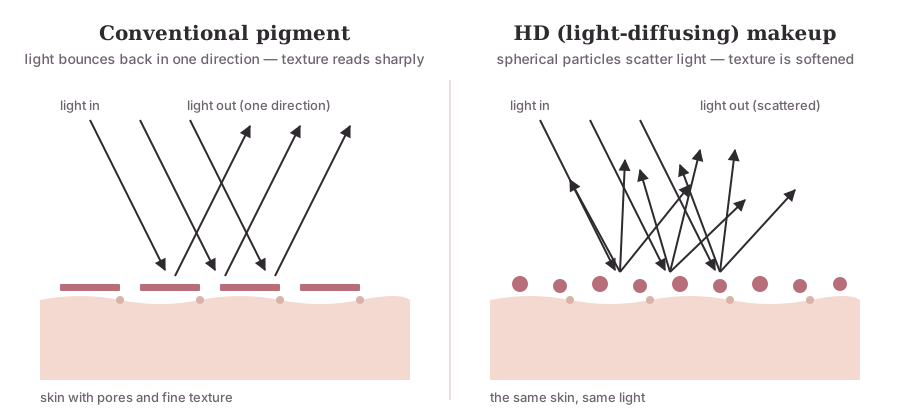
Conventional pigment particles are relatively large and flat. Light bounces off them in one direction, so the camera records the surface exactly as it is — including pores, fine lines and the texture of the product itself. Add more product to hide texture and you add more visible layer.
Light-diffusing particles are small and spherical. Light entering them scatters in many directions. The camera receives light from a pore and its surroundings blended together, so the pore appears softer. This is the same principle a soft-focus filter uses. The particles do not fill the pore; they change how light reports it.
Fine milling does the rest. A finely milled pigment lays flat across the skin instead of collecting in creases, so coverage can be built in thin passes with no visible edge.
The particle most responsible for the effect is silica — and the same property that makes it useful creates the one real risk of HD makeup. Silica diffuses light beautifully in normal light, but under a direct camera flash its many tiny surfaces reflect the flash straight back at the lens, producing a white cast (see Flashback below).
What an HD makeup kit contains
"HD" appears on most product types. This is what each one is for, and what actually makes it different from its conventional counterpart.
| Product | What "HD" means here | What it does in the look |
|---|---|---|
| HD primer | Usually silicone-based, smooths texture and gives a slip surface | Fills fine lines and pores so thin foundation lays flat |
| HD foundation | Finely milled pigment, often in a silicone or silicone-water emulsion, buildable coverage | The base: sheer to medium in one pass, fuller in two, no visible edge |
| HD concealer | Same fine pigment in a more concentrated formula | Spot coverage that blends into the foundation without a ridge |
| HD loose powder | Very light, silica-dominant, colourless or near-colourless | Sets without adding colour or weight; oil control; soft-focus |
| HD compact / pressed powder | Finely milled powder with binders | Touch-ups; less silica than loose HD powder in most lines |
| HD blush and contour | Finely milled, low-shimmer, blendable | Dimension that photographs as skin, not as a stripe |
| HD setting spray | Film-forming spray | Melts powder into the base, extends wear |
Tools matter as much as products: a dense buffing brush or a damp beauty sponge to press thin layers into the skin, a fluffy powder brush (never a puff) for silica powders, and clean tools for every client — HD's thin layers show every streak, so hygiene and technique go together.
HD makeup technique: how it is applied
The sequence a professional follows, and why each step is there:
- Skin preparation. Cleanse, hydrate, and let moisturiser absorb fully. HD makeup magnifies dryness and flaking because it does not mask texture with weight.
- Colour correction where needed. Because the base will be thin, discolouration (darkness under the eyes, redness around the nose) is corrected first with a small amount of colour corrector, not covered with extra foundation. See colour correction for which corrector does what.
- Primer, sparingly. A pea-sized amount, pressed into the areas that need smoothing (T-zone, cheeks, around the nose), not spread everywhere.
- Foundation in thin passes. Buff or press, do not swipe. Build only where coverage is needed. The face should not have one uniform thickness of product.
- Concealer after foundation. Only where the foundation did not finish the job — thin, blended edges.
- Set lightly. Loose HD powder with a fluffy brush, pressed where the skin gets oily (T-zone, under the eyes), lightly elsewhere. Heavy powdering undoes the whole point and invites flashback.
- Cream before powder for colour. Cream blush or contour under the powder photographs more like skin; powder colour goes on top only if needed.
- Setting spray, held at arm's length, to marry the layers.
- Check under flash. One phone photo with the flash on, in a dim corner, before the client leaves the chair.
HD makeup vs regular makeup
| Regular (conventional) makeup | HD makeup | |
|---|---|---|
| Pigment | Larger, often platelet-shaped | Finely milled |
| Light | Reflected in one direction | Diffused in many directions |
| Coverage approach | Build coverage by adding product | Build coverage in thin, targeted layers |
| Finish on camera | Can show texture, edges and powder | Reads as skin at high resolution |
| Finish in person | Can look heavier close up | Looks lighter close up |
| Setting powder | Talc-based, some colour | Silica-based, near-colourless |
| Flash photography | Depends on SPF content | Depends on how much silica is used |
| Skill dependence | Moderate | High — thin layers show technique |
| Cost of products | Lower to mid | Mid to professional |
The honest summary: HD products give an artist better tools, and a skilled artist can achieve an HD-quality finish with well-chosen conventional products. Neither the label nor the price guarantees the result; the technique does.
HD makeup vs airbrush makeup
These are different categories of thing. HD describes products and finish. Airbrush describes an application method: a thin, purpose-made foundation sprayed as a fine mist through an airbrush gun. Airbrush makeup can itself be marketed as HD, and HD liquid foundations are usually applied with brushes or a sponge. Which suits a bride depends on her skin, the event and the artist's strengths; the two are compared properly in our airbrush makeup guide and the HD vs airbrush comparison (both in preparation in this knowledge hub).
Who HD makeup suits
Most skin types, with adjustments.
- Oily and combination skin benefit most: silica-based powders absorb oil, and thin layers stay put better than heavy ones through heat.
- Normal skin gets the classic result — invisible base, natural dimension.
- Dry skin needs more preparation and less powder. HD powder over-applied on dry skin emphasises flaking; set only where the skin actually shines.
- Mature skin suits HD foundation well because thin layers do not settle into lines the way heavier bases do — but HD powder should be minimal, and cream products should carry the colour.
- Textured or acne-prone skin is helped by silicone primer and diffusion, but HD makeup is not a treatment and does not remove texture; expectations should be set honestly in the consultation.
- Sensitive skin: HD does not mean hypoallergenic. Check ingredients as you would for any product and patch test before a wedding.
How long HD makeup lasts
There is no standard number, and any page that gives one without conditions is guessing. Wear time depends on skin preparation, the formula, how thinly it was applied, and the climate. With proper preparation and light setting, a professional HD base is expected to hold through a full wedding function; in heat and humidity, brief touch-ups for oil are normal and should be planned for. Thin layers are actually an advantage here — a heavy base breaks down in one visible sheet, a thin one wears gradually.
Advantages and limitations
Advantages
- Reads as skin in photographs and video at high resolution
- Lighter feel and look than a full-coverage conventional base
- Buildable: coverage only where needed
- Silica powders control oil without adding colour
- Suits a wide range of skin types when applied correctly
Limitations
- Depends heavily on technique; poor application shows more, not less
- Silica-heavy powders carry a flashback risk under direct flash
- Not a fix for texture, and not waterproof or sweat-proof by definition
- Professional-line products cost more
- "HD" on a label is a marketing description, not a tested standard
Flashback: the HD trade-off most guides skip
Flashback is the ghostly white cast that appears on the face in flash photographs while the rest of the picture looks normal. The two main causes are silica — the same light-diffusing ingredient that makes HD powders work — and the physical sunscreen ingredients zinc oxide and titanium dioxide, which are opaque white minerals that reflect light.
In ordinary light, the many tiny surfaces of a silica powder scatter light in every direction, which is exactly the soft-focus effect. Under a direct flash, those same surfaces reflect the flash back at the lens, and the camera records white where the powder is thickest — usually under the eyes and across the T-zone.
Practical rules:
- Use HD loose powder sparingly, with a fluffy brush, pressed only where needed.
- Prefer a base without SPF for events with flash photography (daytime sun protection is a separate decision).
- Test under flash — one phone photo with the flash on in a dim room tells you everything.
- If a client insists on a heavy powder set, a light dusting of a talc-based, tinted powder over the silica reduces the reflection.
Common mistakes
- Treating "HD" as "more coverage" and applying a heavier base.
- Powdering the whole face with silica powder, then wondering about the white cast in photos.
- Skipping skin preparation: HD makeup shows dry patches instead of hiding them.
- Using powder blush and contour under thin foundation, so the colour sits on top instead of in the skin.
- Checking the look only under the studio's LED panels. Studio light is even and flattering; a wedding photographer's flash is neither.
From Chhaya Yadav's experience
Observations from bridal work and teaching in Jaipur — professional observations, not statistics.
- Jaipur's dry heat and dust change the rules. A thin HD base with light setting holds up better through a long function here than a full-coverage base; heavy layers crack in dry heat and pick up dust at the edges.
- Brides ask for HD expecting heavier coverage. In the consultation I explain that HD is thinner, and that the photographs — not the mirror at arm's length — are the test. Once they see a flash photo of a thin base next to a heavy one, the conversation changes.
- The commonest student mistake is over-powdering. Students learn that HD powder "sets" the look and use it like conventional powder. The result is a white cast in every flash photo. A fluffy brush and half the powder they think they need is the fix.
- Studio light lies. Our LED panels are even and kind; the photographer's on-camera flash is a hard, direct light. Every trial finishes with one flash photo in the dimmest corner of the studio.
- Skin preparation matters more than the label. The best HD foundation on unprepared skin looks worse than a modest foundation on skin that was cleansed, hydrated and given ten minutes to absorb the moisturiser.
Frequently asked questions
What does HD stand for in HD makeup? High definition. The term came from the film and television industry when high-definition cameras started showing every pore and heavy layer of foundation, and brands began formulating finer, thinner products that stayed undetectable on those cameras.
Is HD makeup heavier than normal makeup? No — it is usually lighter. HD products are finely milled and applied in thin, buildable layers. Brides often expect "HD" to mean more coverage; it means smoother, more invisible coverage.
Is HD makeup good for oily skin? Generally yes. Silica-based HD powders absorb oil and blur shine, and thin layers hold better than heavy ones. Skin preparation and a light setting routine matter more than the label.
Does HD makeup cause flashback in photos? It can, if silica-heavy powder is over-applied. Silica diffuses light beautifully in normal light but reflects a camera flash directly, giving a white cast. Use HD powder sparingly with a fluffy brush and test under flash before an event.
How long does HD makeup last? With proper skin preparation and light setting, a professional HD base is expected to hold through a full function; in heat and humidity, light touch-ups for oil are normal. Wear time depends on prep, formula and climate, not on the "HD" label.
What is the difference between HD makeup and airbrush makeup? HD refers to the products and finish; airbrush refers to the application method — a fine mist sprayed from an airbrush gun. You can apply HD products with brushes or, in some cases, through an airbrush.
Key takeaways
- HD makeup is finely milled, light-diffusing makeup applied in thin layers so it stays undetectable at high resolution — lighter, not heavier.
- The effect comes from spherical particles (mainly silica) scattering light; the skin's texture is softened, not removed.
- "HD" is a formulation trend and a marketing term, not a tested standard. Technique decides the result.
- Silica brings a flashback risk under direct flash: powder sparingly, avoid SPF-heavy bases for flash events, and always test with the flash on.
- It suits most skin types with adjustments — oily skin benefits most; dry and mature skin need preparation and minimal powder.
Related reading
- Professional makeup courses at the academy — bridal, HD and airbrush training in Jaipur
- About Chhaya Yadav — the artist and educator behind these articles, and how they are reviewed
- HD bridal makeup at Chhaya Shankar Makeovers — the studio's HD bridal service